
The Nine Practices
A Daily Shugyō
Dear Friend,
If I were allowed to teach you only one thing about becoming a truly great martial artist—one thing that would matter more than style, technique, talent, or even strength—it would be this:
Greatness is not built by intensity.
It is built by daily conduct.
Every serious martial artist eventually learns this the hard way.
Not in their first few years.
Not when training is new and exciting.
But later—
when life gets heavier,
when the body no longer forgives sloppiness,
when motivation becomes unreliable,
and when excuses start to sound reasonable.
That is the moment when most people quietly plateau.
And it is also the moment when the great ones separate themselves.
What the Masters Knew (That Most Students Never Learn)
People love to quote the old masters.
Very few are willing to live the way they lived.
Miyamoto Musashi didn’t write The Book of Five Rings to inspire people.
He wrote it to document how a man must conduct himself daily if he wishes to master the Way.
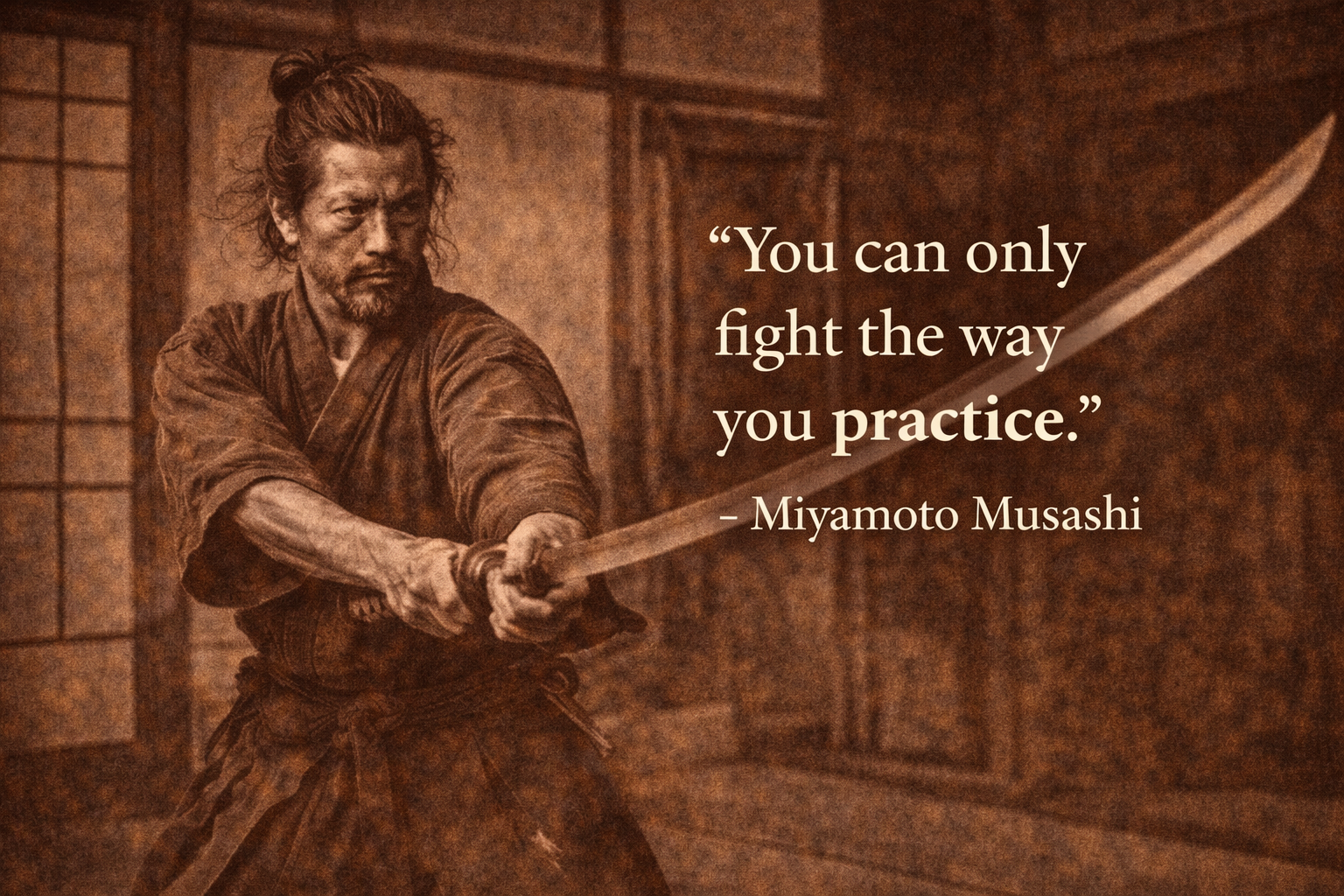
“See to it that you temper yourself with one thousand days of practice,” Musashi wrote,
“and refine yourself with ten thousand days of training.”
That wasn’t poetry.
It was instruction.
Musashi wasn’t talking about inspiration.
He was talking about daily shugyō.
Yukiyoshi Sagawa, one of the most formidable Daitō-ryū practitioners of the modern era, was even more direct.
“Intermittent training, no matter how intensive, is utterly useless,” he said.
“You must practice every day for your entire life. That, and only that, is true training—or shugyō.”
Sagawa didn’t talk about secrets.
He talked about bodies.
He trained daily into old age, forging strength, connection, and power long after others had retired or softened.
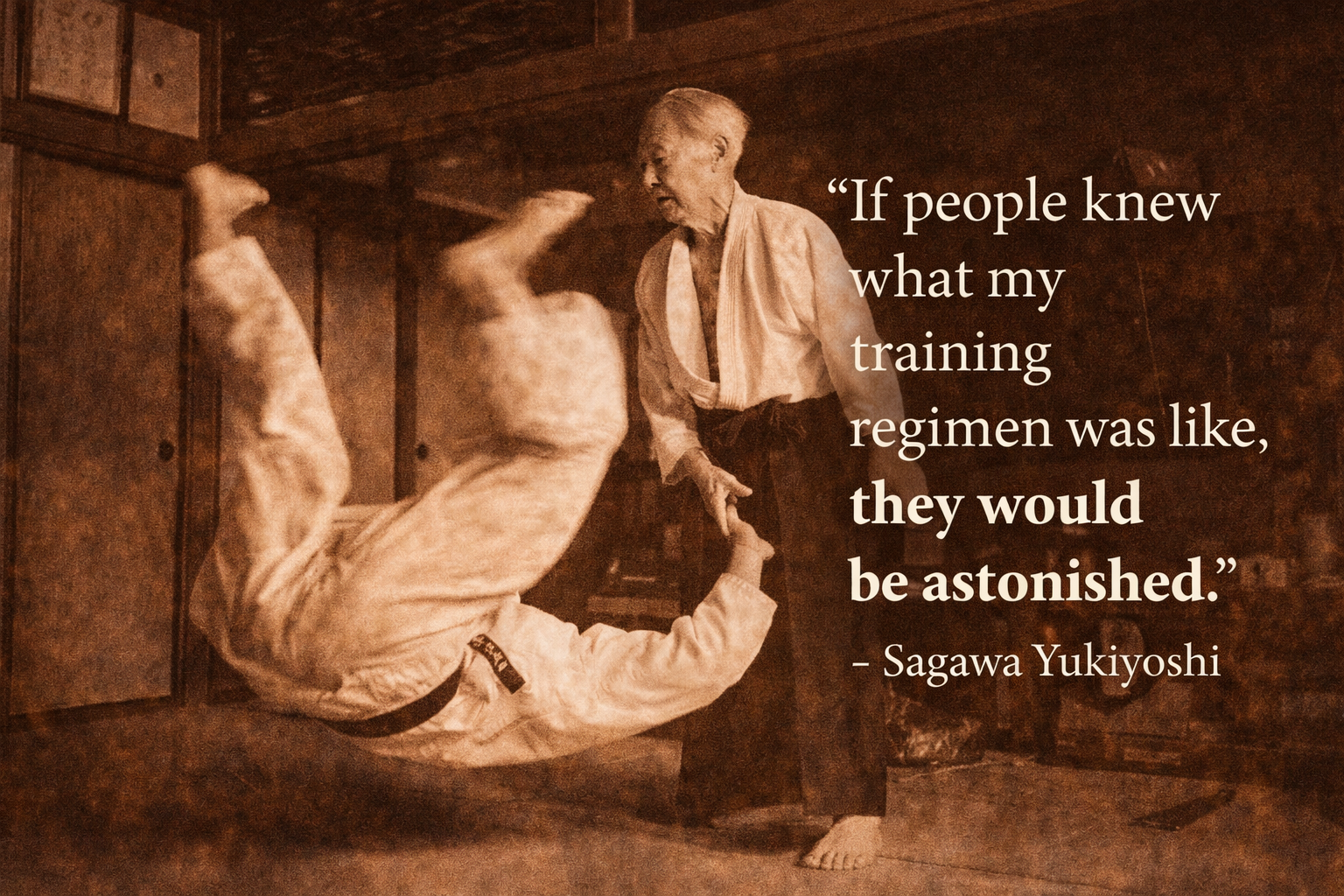
“If people knew what my training regimen was like,” he said,
“they would be astonished.”
Not because it was flashy.
But because it was relentless.
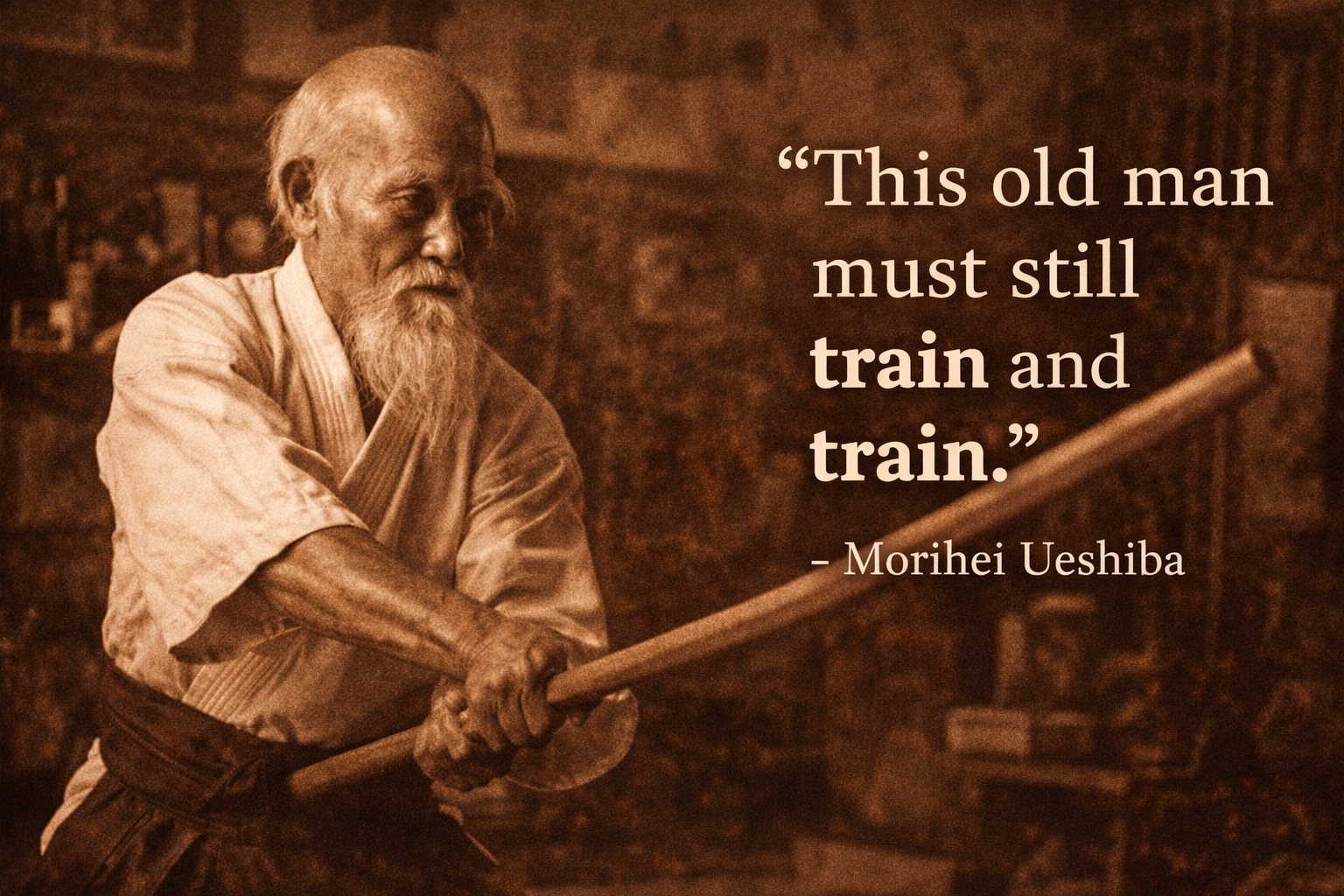
Morihei Ueshiba, the founder of Aikido, never stopped training.
Even after achieving legendary status, he subjected himself to severe daily solo practice—standing, breathwork, weapons, and purification.
John Stevens recounts how Ueshiba would rise before dawn for prayer and misogi, then swing heavy swords hundreds of times before technical practice even began.
And even in old age, Ueshiba would say:
“This old man must still train and train.”
That wasn’t humility.
It was understanding.
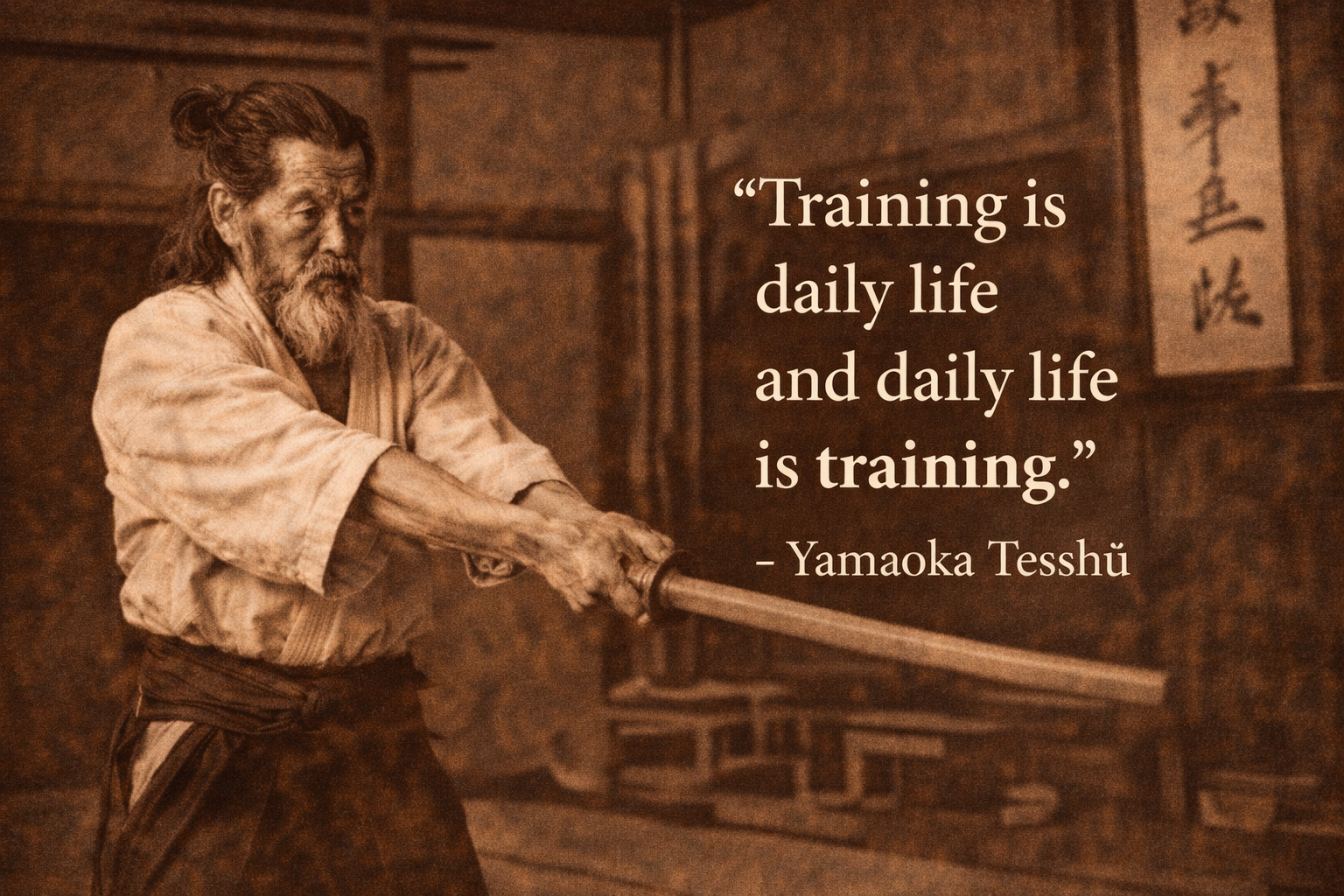
Yamaoka Tesshū, the great swordsman and Zen master, took this even further.
“Study hard and all things can be accomplished,” he said.
“Undergo severe training, abandon body and mind.”
For Tesshū, training was not something you did in addition to life.
Training was life.
Sword practice.
Meditation.
Calligraphy.
All were tools for stripping away illusion through daily discipline.
Different men.
Different arts.
Different centuries.
But if you strip away the mythology and look at how they actually lived, the pattern is unmistakable.
They trained alone.
They trained daily.
They trained whether they felt like it or not.
That way of training has a name.
Shugyō.
What Shugyō Really Means
Shugyō (修行) does not mean suffering for the sake of suffering.
It does not mean theatrical hardship or romantic extremes.
It means:
Conduct that inspires mastery.
In plain language:
You train in a way that removes your ability to negotiate with yourself.
You stop asking, “Do I feel like training today?”
And start asking, “What is required of me?”
That single shift is the difference between people who train
and people who become great.
The Question That Wouldn’t Leave Me Alone
After decades of training, teaching, and watching martial artists come and go, I asked myself a question that most people never ask:
If I stripped away styles, techniques, and mythology—
what daily solo practices actually survive decades of real life?
Not what looks impressive.
Not what sells well.
What still works:
when motivation is gone
when time is limited
when the body demands intelligence instead of abuse
when life refuses to cooperate
The answer was not complicated.
It was simple.
And that’s why most people ignore it.
The Nine Practices
What emerged were nine daily practices—
nine solo disciplines that together cover the full spectrum of warrior development:
Body.
Breath.
Mind.
Integration.
These practices are not a style.
They are a way of training.
They don’t entertain you.
They change you—slowly, quietly, and permanently.
Every day begins the same way.
You stand.
Immovable Standing teaches you how to remain calm while the body is under load.
No movement to hide behind.
No distraction.
Just posture, breath, and attention.
Most martial artists rush past this.
That’s why they never truly own their structure.
Then comes breath.
Not after effort—before it.
Misogi Breath teaches you to regulate the nervous system before power ever appears.
Ueshiba understood this deeply.
Strength without breath is just tension.
And tension always betrays you under pressure.
Then comes repetition.
Not variety.
Repetition.
The Thousand Cuts are not about numbers.
They are about intent.
Same movement.
Same posture.
Same focus.
Over and over.
Musashi lived here.
This is how tendons adapt.
This is how transmission develops.
This is how skill stops being theoretical.
Then movement.
Line-Stepping Footwork teaches distance, readiness, and silent control.
No wasted steps.
No noise.
This is battlefield awareness stripped of fantasy.
Then the body must be prepared to be used.
Sagawa was ruthless about this.
Wall-Root Isometrics build whole-body connection without momentum or cheating.
If the body isn’t prepared, technique is fantasy.
These practices remove fantasy.
Then everything slows down.
Slow Form and Shadow Technique remove speed so mistakes cannot hide.
Every shift of weight matters.
Every transition is felt.
This is where technique becomes yours.
Then the hands tell the truth.
Tenouchi and Grip Forging reveal tension immediately.
This is why warriors always trained their grip—not for brute strength, but for relaxed authority.
Then endurance.
Not aggressive.
Not forced.
The Solitary Conditioning Walk builds endurance as a mental quality.
Time.
Distance.
Breath.
No stimulation.
Just continuation.
And finally, integration.
The Sword and the Brush close the loop.
Because training without reflection is just activity.
You write.
You sit.
You observe.
Tesshū would recognize this immediately.
Simple Does Not Mean Easy
It Means Sustainable
These nine practices are simple.
They are not easy.
And they are designed to be practiced for years, not weeks.
That is the point.
If a practice requires excitement, it will fail.
If it requires perfect conditions, it will collapse.
Shugyō survives because it works when life is imperfect.
Daily Shugyō Is the Real Divider
Here is the line most martial artists will never cross:
Twenty to forty-five minutes.
Every day.
Alone.
Not heroic.
Just honest.
Stillness.
Breath.
One physical discipline.
Reflection.
That is daily shugyō.
And daily shugyō is what separates dabblers from masters.
Who This Is For
This is not for everyone.
It is not for people who need motivation.
It is not for people who want entertainment.
It is not for people unwilling to train alone.
It is for:
serious martial artists
lifelong practitioners
men over 35–40
those tired of restarting
those who understand that mastery is quiet
This course will not push you.
It will not remind you.
It will not chase you.
It simply exists.
What you do with it tells you everything.
The Invitation
This program is called:
The Nine Practices
A Daily Shugyō
It is a modern transmission of the daily training conduct shared by Musashi, Sagawa, Ueshiba, and Tesshū—distilled into a form you can practice for the rest of your life.
No hype.
No countdown.
No pressure.
If this resonates, you already know.
If it doesn’t, walk away.
Shugyō has never chased anyone.
Final Word
“The way lies in training,” Musashi said.
Training lies in daily conduct.
Conduct lies with you.
That truth hasn’t changed in a thousand years.
P.S. — Read This Carefully
This program is not designed to motivate you.
It is designed to replace motivation with conduct.
If you need hype, reminders, accountability calls, or someone to “keep you on track,” this will not work for you.
If you are capable of training alone, quietly, every day—this may be the most important training resource you ever own.
P.P.S. — Why This Matters More Than Technique
Most martial artists obsess over techniques they will never truly own.
Musashi warned against this centuries ago.
Sagawa dismissed it outright.
Ueshiba trained past it.
Tesshū stripped it away.
Daily shugyō builds the body and mind capable of expressing technique under pressure.
Without that foundation, technique is decoration.
P.P.P.S. — About Time (Because Everyone Asks)
This does not require hours a day.
The core practice is 20–45 minutes daily.
That’s it.
But here’s the catch:
It must be done every day, regardless of mood.
If that sounds unreasonable to you, this is not your path.
